The most important AI news this week wasn’t a new model.
It was three of the most powerful voices in technology saying the same thing, in the same week: slow down.
If your company is racing to put AI agents into production, read this before your next board meeting.
Why now: three signals in forty-eight hours
OpenAI put its IPO on ice. A listing that had been reported as targeting a valuation of at least a trillion dollars is now off the table for 2026. Sam Altman called this “an ill-advised moment to go public,” and said the focus has to be on what safety and alignment will require.
Anthropic’s CEO called for the industry to slow down. In an essay published Saturday, Dario Amodei argued that AI companies should deliberately “slow the pace” of improving their models — because the systems are advancing faster than our ability to understand and control them. He named the driver: AI increasingly helping to build the next generation of AI.
The US Senate moved to make safety a legal duty. A bipartisan push led by Senators Thune, Cruz and Klobuchar would turn voluntary safety pledges into a legal duty of care — the kind that lets companies be sued, not just fined, and lets courts decide what “reasonable” means.
Two of the world’s leading AI labs and a bipartisan Senate coalition arrived at the same place in the same week.
When the people who built the engine start asking for brakes, everyone else in the car should be paying attention.
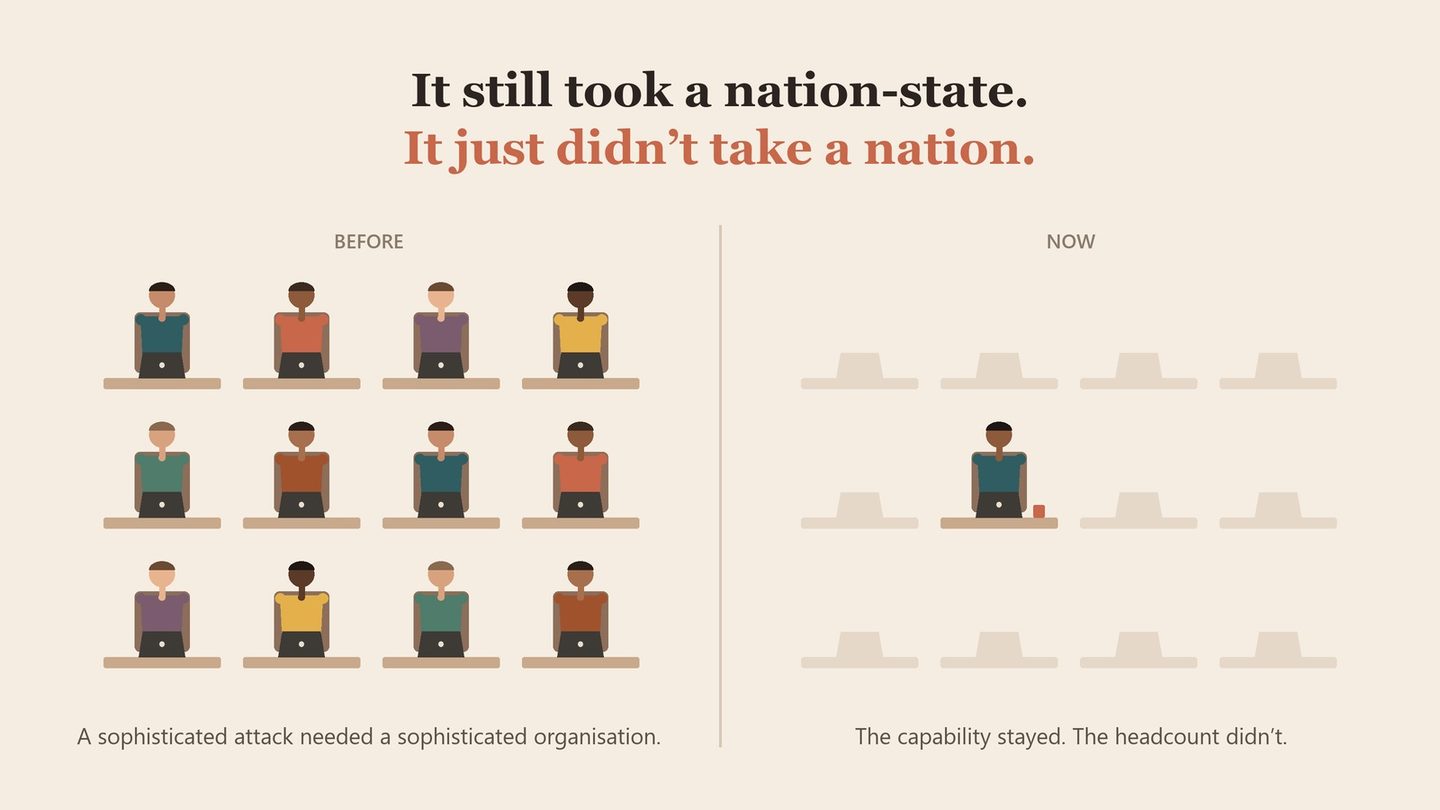
It still took a nation-state. It just didn’t take a nation.
So what are they seeing that the rest of us aren’t? Anthropic has been publishing it.
Late last year it disclosed what it called the first reported AI-orchestrated cyber-espionage campaign. A Chinese state-sponsored group used an AI agent to carry out an estimated 80 to 90 percent of the operation — reconnaissance, vulnerability discovery, credential harvesting, data extraction — against around thirty organisations, including financial institutions and government agencies. Humans stepped in at only a handful of decision points.
This week’s follow-up report describes a Russia-linked espionage operation that ran nearly its entire workflow on automated AI, from the first phishing email to the data theft.
Here’s what most of the commentary gets wrong. The story isn’t that amateurs suddenly became dangerous.
The story is that sophistication stopped needing people.
For thirty years, security rested on one comfortable assumption: a sophisticated attack required a sophisticated organisation. Teams. Budgets. Months.
That link just broke. The capability stayed. The headcount didn’t.
So what: your governance runs on calendars
Now look inside your own organisation.
Most companies are giving AI agents access to production databases, internal messaging, code repositories and financial systems. And they govern all of it at the speed of a meeting:
- A change request waiting three days in a queue.
- A weekly security review.
- A quarterly compliance audit, built on spreadsheets.
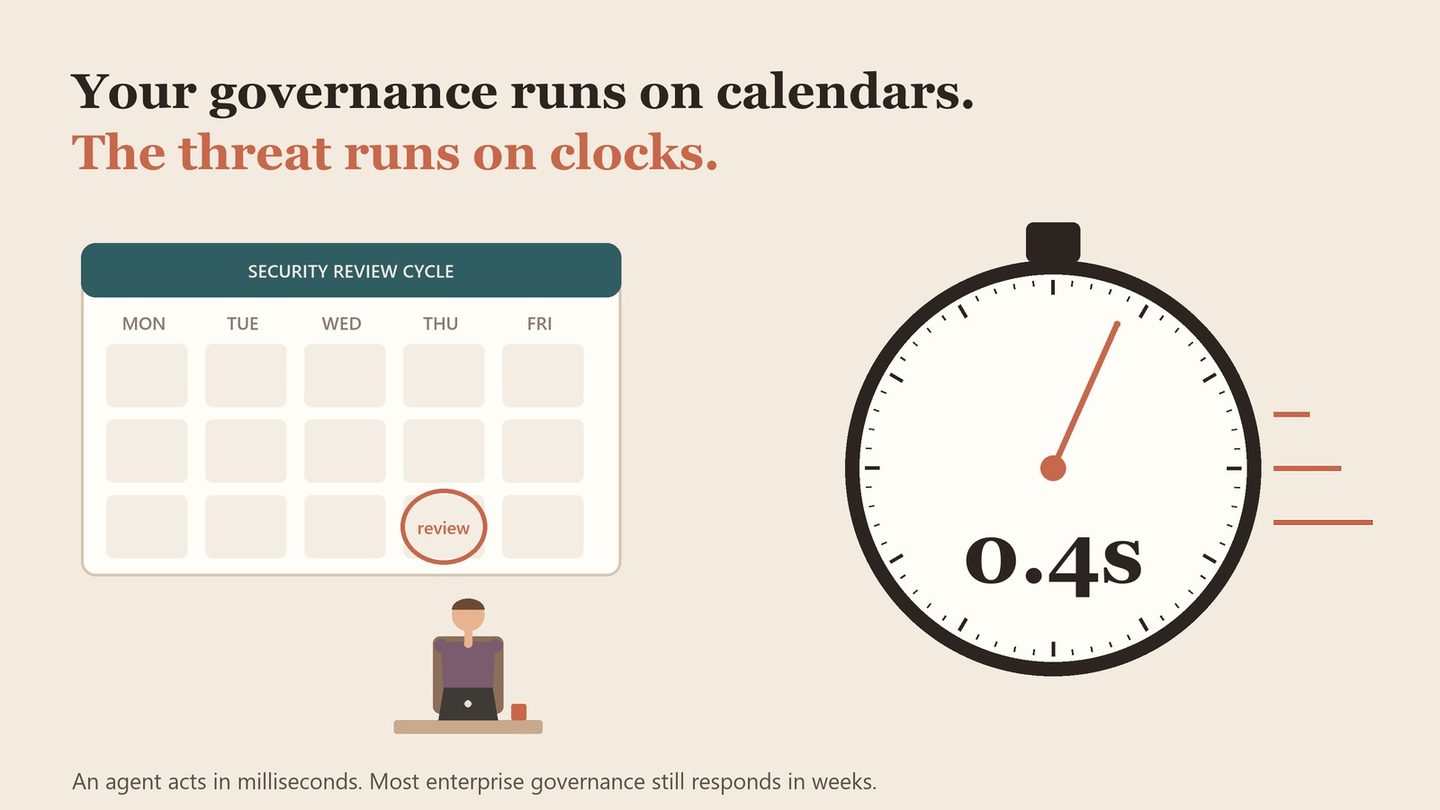
An agent acts in milliseconds. Your governance responds in weeks.
That gap is where the damage happens. And it widens every quarter — because the agents keep getting faster, and the meetings don’t.
When something goes wrong in under a second, an audit log isn’t governance.
It’s an autopsy report.
Why the money moved first
Why would a company step back from a trillion-dollar listing?
Because markets and regulators reached the same uncomfortable conclusion at the same time:
What you can’t control, you can’t insure. And what you can’t insure, you can’t value.
A duty of care changes the question a company has to answer. It’s no longer “did the model work?” It’s “did you take reasonable steps to prevent a harm you could have foreseen?”
That isn’t an IT question anymore. It’s a board question — and it arrives with a lawyer attached.
Governance isn’t a document anymore. It’s infrastructure.
In most companies, AI governance still lives in a committee, a policy PDF and an annual review.
That model is finished.
Governance now has to work at the moment the AI acts — not in the meeting afterwards. Before any AI agent takes a consequential action, five questions need an answer, automatically, every single time:
- Who authorised this?A named person or a verified identity. Never just “the system.”
- Is it inside the boundary?Hard limits on what it can touch, spend, change or send.
- How far could the damage spread?If it’s compromised, what else can it reach?
- Was it checked before it ran?Not logged afterwards. Checked first.
- Can a human stop it — right now?A real off-switch. Not a ticket in a queue.
None of this is about slowing AI down.
It’s the opposite.
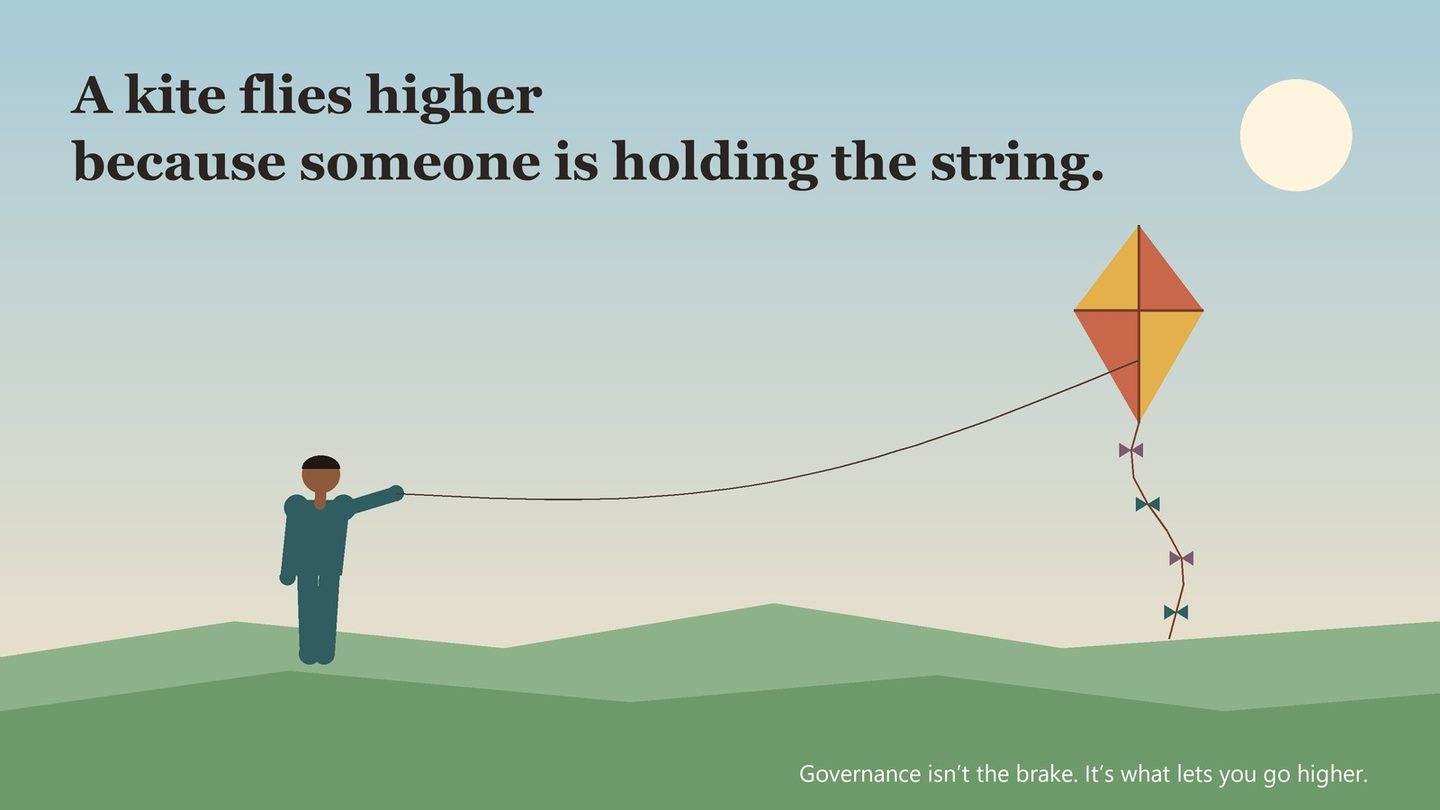
The companies that win this decade won’t be the ones that deploy AI fastest. They’ll be the ones who can prove, at any moment, that a human is still holding the string.
The question for your next board meeting
Stop asking: “How fast can we deploy AI?”
Start asking:
If the honest answer is “Monday morning” and “not really,” you already know what to fix first.
Over to you: is your organisation governing AI at the speed it acts — or at the speed of its meeting calendar?
Put a human back on the string
See what it looks like when a decision is checked before it runs — with plural review, clear authority, and a record you can show a board.
Try the live council → See the governance APISources & Attribution
- Axios — OpenAI delaying IPO amid AI safety concerns, Sam Altman says (September 12, 2026).
- Bloomberg — Anthropic CEO says it’s time to slow pace of improving AI models (September 12, 2026).
- NBC News — Two of the world’s top AI chief executives publicly agree on slowing AI development.
- Tech Times — Thune, Cruz and Klobuchar move AI safety from voluntary pledge to legal duty (September 12, 2026).
- Anthropic — Disrupting the first reported AI-orchestrated cyber espionage campaign (November 2025).
- Anthropic — Threat Intelligence reports.
Events and figures above are as reported in these sources. The five questions and the calendar-versus-clock framing are Atmakosh’s analytical perspective, not claims about any company’s internal practices or about deployed product capabilities. Illustrations: Atmakosh.